Agrobiodiversidad y servicios ecosistémicos en las agrosilviculturas urbanas y periurbanas de Mérida, Yucatán
Keywords:
Agrobiodiversidad, beneficios, alimentos, huertos familiares, manejoAbstract
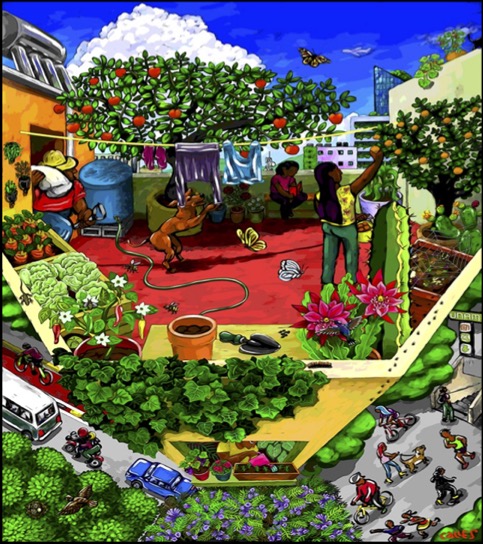
The city of Merida, located in the southeast of Mexico, is experiencing rapid population, infrastructure and services growth that generate changes in daily dynamics, consumption habits, and the demand and supply of food. In the face of these changes, urban and peri-urban gardens represent spaces of resistance where food is produced, diverse species are managed, and people socialize, live and smile. These agroecosystems, their diversity and the benefits they provide to people, are important to recognize and protect them, conserve them and promote their implementation. Therefore, this research aimed to characterize the agrobiodiversity of urban and peri-urban gardens in Mérida, as well as the perception that families have about the ecosystem services they provide. 14 agroforestry gardens were located and the people who manage them agreed to collaborate actively in each of the phases of the project. A questionnaire was designed, validated and applied, addressing topics related to demography, agrobiodiversity, pests, management of domestic and wild flora and fauna, perception of benefits, among others. 143 species were recorded, grouped into 58 botanical families, where Fabaceae and Rutaceae are best represented with 16 and 13 species. The most frequent species were Citrus aurantium (sour orange) and Lippia graveolens (oregano), which are important ingredients in local cuisine. The people interviewed indicated that the garden provides them with eleven benefits, predominantly food (71%), home for animals and plants (64%), and oxygen production (64%). Gardens are important for families, since they obtain food and various satisfactions from them. The importance of caring for each component is recognized, the domesticated and the wild, the plants and the animals, because each has an important role to play. Urban and peri-urban agroforestry promotes green colonies, and neighborhoods, which are roadmaps to strengthen social cohesion and the development of collective actions in the urban territory where we live.
References
Alcántara-Nieves, N., y R.M. Larroa-Torres. 2022. La multifuncionalidad de los huertos urbanos en la Ciudad de México. Espiral (Guadalajara) 29(83): 187-229.Calvet-Mir, L., C. Riu-Bosoms, M. González-Puente, I. Ruiz-Mallén, V. Reyes-García, and J.L. Molina. 2015. The Transmission of Home Garden Knowledge: Safeguarding Biocultural Diversity and Enhancing Social–Ecological Resilience. Society & Natural Resources 29(5): 556–571. https://doi.org/10.1080/08941920.2015.1094711
Carrillo-Niquete, G. A., J. L. Andrade, J. R. Valdez-Lazalde, C. Reyes-García y J. L Hernández-Stefanoni. 2021. Characterizing spatial and temporal deforestation and its effects on surface urban heat islands in a tropical city using Landsat time series. Landscape and Urban Planning 217: 1?13. https://doi.org/10.1016/j.landurbplan.2021.104 280
Constanza, R., R. D’Arge, R. Groot, S. Farber, M. Grasso, B. Hannon, K. Limburg, S. Naeem, R. O’Neill, J. Paruelo, R. Raskin, P. Sutton, and M. Belt. 1997. The value of the world’s ecosystem services and natural capital. Nature 387: 253-260. https://doi.org/10.1038/387253a0
Diaz, S., S. Demissew, C. Londsdale, and A. Lariagauderie. 2015. A roseta Stone for natures benefits to people. PloS Biology 13(1): e1002040. https://doi.org/10.1371/journal.pbio.1002040
Diaz, S., S. Demissew, C. Londsdale, and A. Lariagauderie. 2015. A roseta Stone for natures benefits to people. PloS Biology, 13(1): e1002040. https://doi.org/10.1371/journal.pbio.1002040
Durán, R., y M. Méndez. 2010. Selva baja caducifolia con cactáceas candelabriforme. Biodiversidad y desarrollo humano en Yucatán. CICY, PPDFMAM, CONABIO, SEDUMA., Mérida, Yucatán, México.
Emery, M.R., and P.T. Hurley. 2016. Ethnobiology in the city: Embracing the urban ecological moment. Journal of Ethnobiology 36(4): 807–819. https://doi.org/10.2993/0278-0771-36.4.807
Espadas-Manrique, C., C. Reyes-García y G. Carrillo-Niquete. 2021. La expansión urbana de Mérida, la de Yucatán, México y su contribución al cambio climático. Desde el Herbario CICY 13: 232–238.
Estrada-Medina, H., J.J. Jiménez-Osornio, O. Álvarez-Rivera, y R.C. Barrientos-Medina. 2019. El karst de Yucatán: su origen, morfología y biología. Acta universitaria 29: e2292. https://doi.org/10.15174/au.2019.2292
Fu, B., S. Wang, C. Su, and M. Forsius. 2013. Linking ecosystem processes and ecosystem services. Environmental Sustainability 5(1): 4-10. https://doi.org/10.1016/j.cosust.2012.12.002
Galluzzi, G., P. Eyzaguirre, and V. Negri. 2010. Home gardens: neglected hotspots of agro-biodiversity and cultural diversity. Biodiversity and Conservation 19:36353654. https://doi.org/10.1007/s10531-010-9919-5
García-Flores, A., E. Farfán-Estrada, R. Monroy-Martínez, C. Monroy-Ortiz, H. Colin-Bahena, y J.M Pino-Moreno. 2019. Fauna registrada en huertos frutícolas tradicionales de Yautepec, Morelos, México. Tropical and Subtropical Agroecosystems 22: 359-378.
García-Gómez, C., O. Ruiz-Salazar, y C. Tonatiuh. 2011. La segregación territorial y el rezago en el sur de la ciudad de Mérida, como el resultado del crecimiento urbano descontrolado. Quivera 13(1): 122-138.
González Herrera, R. A., B. S. I. Albornoz Euán, I.A. Sánchez y Pinto, y J.H. Osorio Rodríguez. 2018. El acuífero yucateco. Análisis del riesgo de contaminación con apoyo de un sistema de información geográfica. Revista internacional de contaminación ambiental 34(4): 667-683. https://doi.org/10.20937/rica.2018.34.04.09
Hurtado-Torres, M. C., P.I. Montañez-Escalante, y J.J. Jiménez-Osornio. 2022. La selva tropical y los servicios ecosistémicos que brinda. Percepciones de una comunidad maya del sur de Yucatán, México. Investigaciones Geográficas (78): 89-106. https://doi.org/10.14198/INGEO.21124
Infante-Ramírez, K., y A. Arce-Ibarra. 2015. Percepción local de los servicios ecológicos y de bienestar de la selva de la zona maya en Quintana Roo, México. Investigaciones Geográficas, Boletín del Instituto de Geografía, UNAM 86: 67-81. https://dx.doi.org/10.14350/rig.36593
Instituto Nacional de Estadística y Geografía (INEGI). 2020. Censo de Población y Vivienda 2020. Disponible en: https://censo2020.mx/ (verificado 07 de septiembre de 2024).
IPBES. 2022. Summary for Policymakers of the Methodological Assessment Report on the Diverse Values and Valuation of Nature of the Intergovernmental Science-Policy Platform on Biodiversity and Ecosystem Services. En Pascual, U., P. Balvanera, M. Christie, B. Baptiste, D. González-Jiménez, C.B. Anderson, S. Athayde, D.N. Barton, R. Chaplin-Kramer, S. Jacobs, E. Kelemen, R. Kumar, E. Lazos, A. Martin, T.H. Mwampamba, B. Nakangu, P. O'Farrell, C.M. Raymond, S.M. Subramanian, M. Termansen, M. Van Noordwijk, and A. Vatn. (eds.). IPBES secretariat. Bonn, Germany. https://doi.org/10.5281/zenodo.6522392
Kowarik, I. 2011. Novel urban ecosystems, biodiversity, and conservation. Environmental Pollution159(8-9): 1974-1983. https://doi.org/10.1016/j.envpol.2011.02.022
Lin, B. B., S.M. Philpott, and S. Jha. 2015. The future of urban agriculture and biodiversity-ecosystem services: Challenges and next steps. Basic and Applied Ecology 16(3): 189-201. https://doi.org/10.1016/j.baae.2015.01.005
MetropoliMid. 2023. Estudio Demográfico y Territorial, Crecimiento de la ciudad de Mérida: Cuantificación y Dimensionamiento de la Periferia Urbana. Disponible en: https://metropolimid.com.mx/wp-content/uploads/2023/09/Estudio-Demografico-y-Territorial-2023.pdf (verificado 07 de septiembre de 2024).
Monroy-Martínez, R., H. Colín-Bahena, M. Gispert-Cruells, A. García-Flores, e I. Ayala-Enríquez. 2016. La gestión comunitaria de la diversidad biológica en riesgo por el crecimiento urbano en el municipio de Yautepec, Morelos, México. Revista Etnobiologia 14(3): 50-59.
Nicholls, C.I. 2008. Control biológico de insectos: un enfoque agroecológico. Ciencia y Tecnología. Universidad de Antioquia, Colombia.
Nogeire-McRae, T., E. P. Ryan, B. B. R. Jablonski, M. Carolan, H. S. Arathi, C. S. Brown, H. H. Saki, S. McKeen, E. Lapansky, and M.E. Schipanski. 2018. The Role of Urban Agriculture in a Secure, Healthy, and Sustainable Food System. BioScience 68(10): 748–759. https://doi.org/10.1093/biosci/biy071
Orellana, R., M. Balam-Ku, I. Bañuelos-Robles, E. García, J.A. González-Iturbe, F. Herrera-Cetina, y J. Vidal-López. 1999. Evaluación climática. En: García de Fuentes, A., J. Córdoba y Ordóñez, y P. Chico Ponce de León (eds). Atlas de Procesos Territoriales de Yucatán. Universidad Autónoma de Yucatán, Mérida, 163–182.
Peterson, N. D. 2010. Choices, options, and constraints: decision making and decision spaces in natural resource management. Human Organization 69(1): 54-64. https://doi.org/10.17730/humo.69.1.82153826v2484743
Pollock, S.L., C. Stephen, N. Skuridina, and T. Kosatsky. 2012. Raising chickens in city backyards: the public health role. Journal of Community Health 37:734-742. https://doi.org/10.1007/s10900-011-9504-1
Pourias, J., C. Aubry, and E. Duchemin. 2016. Is food a motivation for urban gardeners? Multifunctionality and the relative importance of the food function in urban collective gardens of Paris and Montreal. Agriculture and Human Values 33(2): 257-273. https://doi.org/10.1007/s10460-015-9606-y
Salazar-Barrientos, L. de L., M.A. Magaña-Magaña, y L. Latournerie-Moreno. 2015. Importancia económica y social de la agrobiodiversidad del traspatio en una comunidad rural de Yucatán, México. Agricultura, sociedad y desarrollo 12(1):1-14.
Shamsipour, A., H. Heidari, and R. Avatefi. 2024. Estimating of the climate effects of urban gardens with an emphasis on carbon sequestration in Shiraz, Iran. International Journal of Environmental Science and Technology 21: 1379–1388. https://doi.org/10.1007/s13762-023-05334-5
Vallejo, G., F. García, y R. Molina. 2011. Agricultura comercial, tradicional y vulnerabilidad en campesinos. Política y Cultura 36: 71-98.
Wolch, J. R., J. Byrne and J. P. Newell. 2014. Urban green space, public health, and environmental justice: The challenge of making cities 'just green enough'. Landscape and Urban Planning 125, 234-244.