Polinizadores de huertos urbanos y periurbanos en la ciudad de Morelia (Michoacán, México)
Keywords:
agricultura urbana, polinización, abejas silvestres, colibríesAbstract
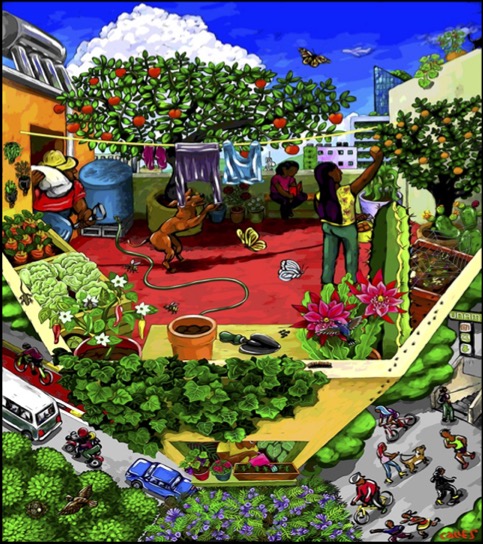
Urban gardens are becoming more and more common in cities, as a way to cover some of the food needs and/or as a need to get closer to nature and a healthier life. Pollinators play an important role in the harvest of these gardens, as they are essential for pollination, a process necessary in most plants for the production of fruits and seeds. In this article, we studied the pollinators of seven urban and periurban orchards in the city of Morelia during an annual agricultural cycle (October 2022 to June 2023). Based on a monthly visit to each space, 5-hour censuses were conducted (between 10 am and 15 pm), in which we noted which pollinator species were seen and on which flowers. Despite the fact that, a priori, cities are a relatively hostile environment for these animals, we found a considerable diversity of pollinators that come to visit the flowers in the orchards (an average of 60 different species, including bees, wasps, flies, butterflies, beetles and hummingbirds). We also saw that each plant species attracted different pollinators. If we want to conserve the valuable role of pollinators and protect biodiversity, we can make urban/peri-urban gardens (and city green spaces in general) friendlier to these animals by taking a number of actions such as planting more flower diversity (including wildflowers), and building pollinator hotels. These actions have a double function: we will benefit from the pollination services and we will have more horticultural production and, at the same time, we will contribute to maintain or even increase the diversity of these insects in the city.
References
Ayala, R., T. Griswold y S.H. Bullock. 1993. The native Bees of Mexico. En: Ramamoorthy T.P., R. Bye, A. Lot y J. Fa. (coords.). Biological Diversity of Mexico. Origin and Distribution. Oxford University Press.
Banco Mundial. 2023. Datos del Banco Mundial. Población Urbana. Disponible en: https://datos.bancomundial.org/indicator/SP.URB.TOTL.IN.ZS?end=2021&start=1960&view=chart (verificado 1 de agosto 2024).
Colino, S. 2022. Las frutas y verduras son menos nutritivas que antes. ¿Por qué? National Geographic. Disponible en: https://www.nationalgeographic.es/ciencia/2022/05/las-frutas-y-verduras-son-menos-nutritivas-que-antes-por-que. (verificado 12 de agosto 2023).
Degenhart, B. 2016. La agricultura urbana: un fenómeno global. Nueva Sociedad. Disponible en: https://www.nuso.org/articulo/la-agricultura-urbana-un-fenomeno-global/ (verificado 1 de agosto 2024).
ENCUSP (Estrategia Nacional para la Conservación y Uso Sustentable de los Polinizadores en México). 2021. Proyecto IKI-IBA, agencia Alemana de Cooperación para el Desarrollo (GIZ) del proyecto “Integración de la Biodiversidad en la Agricultura Mexicana” (IKI-IBA), al Ministerio Federal de Medio Ambiente, Protección de la Naturaleza y Seguridad Nuclear (BMU) de Alemania, Secretaría de Agricultura y Desarrollo Rural (SADER) y Secretaría de Ambiente y Recursos Naturales (SEMARNAT, Gobierno de México). https://www.gob.mx/agricultura/documentos/estrategia-nacional-para-la-conservacion-y-uso-sustentable-de-los-polinizadores-encusp
IPBES. 2016. The assessment report of the Intergovernmental Science-Policy Platform on Biodiversity and Ecosystem Services on pollinators, pollination and food production. En: Potts, S.G., V. L. Imperatriz-Fonseca y H. T. Ngo, (eds). Secretariat of the Intergovernmental Science-Policy Platform on Biodiversity and Ecosystem Services, Bonn, Germany. https://ipbes.net/assessment-reports/pollinators
Klein A.-M., B.E. Vaissière, J.H. Cane, I. Steffan-Dewenter, S.A. Cunningham, C. Kremen y T. Tscharntke. 2007. Importance of pollinators in changing landscapes for world crops. Proceedings of the Royal Society B 274: 303-313. DOI: 10.1098/rspb.2006.3721
Nava-Bolaños A., L. Osorio-Olvera, G. Soberón. 2022. Estado del arte del conocimiento de biodiversidad de los polinizadores de México. Revista Mexicana de Biodiversidad 93: e933948. https://doi.org/10.22201/ib.20078706e.2022.93.3948
ONU (United Nations). 2019. World Urbanization Prospects: The 2018 Revision (ST/ESA/SER.A/420). Department of Economic and Social Affairs, Population Division. United Nations. New York.
Ollerton, J., R. Winfree, y S. Tarrant. 2011. How many flowering plants are pollinated by animals? Oikos 120: 321-326. https://doi.org/10.1111/j.1600-0706.2010.18644.x
Quesada, M., S. Martén-Rodríguez, O. Delgado Carrillo, E. Paramo-Ortiz, C. Pérez, S. Novais, H.S. De Santiago-Hernández y E.J. Cristóbal Pérez. 2021. Diagnóstico. Situación actual de los polinizadores en México: Diagnóstico del conocimiento y sistematización. Estrategia Nacional para la Conservación y Uso Sustentable de Polinizadores en México Proyecto IKI-IBA, agencia Alemana de Cooperación para el Desarrollo (GIZ) del proyecto “Integración de la Biodiversidad en la Agricultura Mexicana” (IKI-IBA), al Ministerio Federal de Medio Ambiente, Protección de la Naturaleza y Seguridad Nuclear (BMU) de Alemania, Secretaría de Agricultura y Desarrollo Rural (SADER) y Secretaría de Ambiente y Recursos Naturales (SEMARNAT). https://www.gob.mx/cms/uploads/attachment/file/629650/Diagnostico_calidad_media.pdf
Silva, V.H.D. et al. 2023. Diverse urban pollinators and where to find them, Biological Conservation 281:110036. https://doi.org/10.1016/j.biocon.2023.110036
Soga, M. et al. 2017. Gardening is beneficial for health: A meta-analysis. Preventive Medicine Reports 5: 92-99. DOI: 10.1016/j.pmedr.2016.11.007
Youngsteadt, E. y M. Favre. 2022. How to Manage a Successful Bee Hotel. Disponible en: https://content.ces.ncsu.edu/how-to-manage-a-successful-bee-hotel (verificado 14 de agosto 2024).