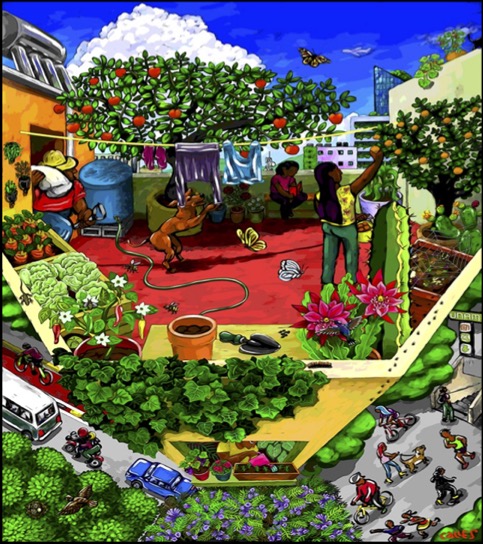
Entre Oasis Sudcalifornianos y Oasis Urbanos de La Paz, Baja California Sur
Keywords:
Soberanía alimentaria, agroecología, recuperación de la oasisidad, PRONAII.Abstract
La Paz, Baja California Sur (BCS), was populated by hunter-gatherer-fishermen who did not practice agriculture. The construction of oasis agrosystems allowed for a sedentary life. However, today, globalization, the vulnerability of arid zones exacerbated by climate change, water deficit, high consumption of imported products, real estate speculation and uncontrolled tourism growth, affect the dynamics to guarantee food sovereignty. For this reason, through a research and advocacy project, the objective was to strengthen the experiences that lead to agroecological transition processes. We work under the methodology of participatory action research. In this document, we reflect on the lived experience and characterize the advances based on the analysis of the environmental history of the South Californian oases and their possible applications for the strengthening of urban oases. We found a diversity of foods grown in the city that enrich agroforestry and that, although they are not named as such, their care practices are close to the agroecologies that together form urban oases. The social incidence of the process has been to contribute to the formation of networks that enable the construction of learning communities for the benefit of food sovereignty.
References
Cariño, M. (2001). La oasisidad: núcleo de la cultura sudcaliforniana, Gaceta Ecológica, INE-SEMARNAT, N. 60, México 2001: 57-69.
Cariño, M. 2014. Oasisidad: identidad geográfica sudcaliforniana y expresión local de la sustentabilidad. En Cariño Micheline y Ortega Antonio (Eds.) Oasis Sudcalifornianos. Para un rescate de la sustentabilidad local. Editorial Universidad de Granada EUG, España: 71-106.
Cariño, M. y A.L. Castillo. 2017. Oasis Sudcalifornianos: paisajes bioculturales con elevada capacidad adaptativa a la aridez y potencial para la construcción de la sustentabilidad local. Revista Fronteiras: Journal of Social, Technological and Environmental Science, 6(2): 217-239, DOI http://dx.doi.org/10.21664/2238-8869.2017v6i2.p217-239.
Cariño, M. 2014. Oasisidad: identidad geográfica sudcaliforniana y expresión local de la sustentabilidad. En Cariño Micheline y Ortega Antonio (Eds.) Oasis Sudcalifornianos. Para un rescate de la sustentabilidad local. Editorial Universidad de Granada EUG, España: 71-106.
Ipiña, G.O. 2016. El espacio público dedicado al ocio en el siglo XXI y la búsqueda de los oasis urbanos. Estoa. Revista de la Facultad de Arquitectura y Urbanismo de la Universidad de Cuenca 9( 5): 81-88.
Ibarra Meza, C. y M. Cariño. 2020. Reexistencia de la oasisidad: resistencia biocultural desde el rancho sudcaliforniano. En: Ortega Santos, A. y Chiara Olivieri (Eds.) Saberes bioculturales en pie de re-existencias en el sur global. Granada: UGR: 149-168.
Moreno Calles, A. y A. Valencia Vásquez. 2024. Nopales, Tsituni, colorines y capulines, legado biocultural que comemos y cuidamos en Morelia, Michoacán, México. Revista Etnobiología 22 ( 1): 36-48.
SANTORO, A. 2023. Traditional oases in Northern Africa as multifunctional agroforestry systems: A systematic literature review of the provided Ecosystem Services and of the main vulnerabilities. Agroforestry Systems (97): 81-96. https://doi.org/10.1007/s10457-022-00789-w
SIAP. 2018. Datos Abiertos: Estadística de la producción agrícola en Baja California Sur. Gobierno de México. http://infosiap.siap.gob.mx/gobmx/datosAbiertos.php
Peña-Azcona I, M.M. Cariño Olvera y Escalona Aguilar M.A. 2024.Oasis urbanos en el desierto sudcaliforniano. Transiciones agroecológicas e historia ambiental aplicada. Revista multidisciplinaria enfocada en las Ciencias Sociales y las Humanidades. Revista de El Colegio de San Luis, (25):5-36.
Rosset, P. y M.E. Martínez-Torres. 2011. La Vía Campesina y Agroecología. Libro abierto de la Vía Campesina: celebrando 20 años de lucha y esperanza
Rosset, P., Sosa, B. M., Jaime, A. M., y D.R.Á, Lozano. 2011. The Campesino-to-Campesino agroecology movement of ANAP in Cuba: Social process methodology in the construction of sustainable peasant agriculture and food sovereignty. Journal of Peasant Studies, 38(1):161–191.
Val, Valentin y Rosset, Peter. 2022. Agroecología(s) emancipatoria (s) para un mundo donde florezcan muchas autonomías (Cooperativas). Chiapas, México.